Is Egypt Safe to Visit in 2026? (Scams, Safety, and the Honest Truth)
“Is it safe?” It’s the first question everyone asks when I tell them I’m heading to Cairo or the Red Sea. In 2026, the answer is a resounding yes—but with a disclaimer: Egypt is very safe from crime, but it is “aggressive” when it comes to your wallet.
While violent crime against tourists is incredibly rare, the “hustle” is at an all-time high. Here is how to navigate Egypt like a pro.
🛡️ The Reality of Safety in 2026
In 2026, the Egyptian government has doubled down on tourist security. You will see:
- Multiple Checkpoints: Especially on the highways between Cairo, Luxor, and Hurghada.
- Tourist Police: Stationed at every major site (look for the white uniforms in summer, black in winter).
- Enhanced Airport Tech: New biometric systems at Cairo (CAI) and Hurghada (HRG) have made arrivals smoother and more secure.
The Verdict: You are safer walking through Cairo at 2:00 AM than you are in many major US or European cities. The “danger” in Egypt isn’t to your person; it’s to your patience.
🛡️ Is Egypt Safe? 5 Scams to Watch Out For
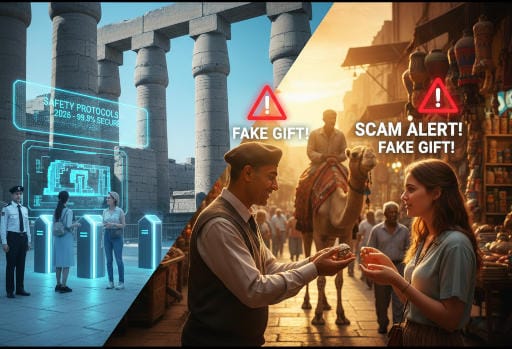
1. The “Free Gift” Trap Someone in the market will press a small souvenir into your hand, saying, “A gift for you!” The second you take it, they will demand a “tip” of £2 or £5.
- The Fix: Hands in pockets. A polite “La, Shukran” (No, thank you) is your best friend.
2. The Camel Ride “Re-Negotiation” You agree on £8 for a ride. Once you are 7 feet in the air, the handler claims that was only to get on, and it’s another £15 to get off.
- The Fix: Only book through your hotel or a trusted site like GetYourGuide. If booking on-site, look the handler in the eye and say: “This is the TOTAL price for up, ride, and down.”
3. The “Broken” Taxi Meter Drivers may claim the meter is broken and ask for a flat fee of £10 for a £3 journey.
- The Fix: Always use Uber where available. If using a white taxi, agree on the price before your bags go in the boot.
4. The “It’s Closed” Trick Strangers near the Pyramids may tell you the main gate is closed to lure you to their shop.
- The Fix: Ignore them. The Pyramids gate doesn’t close for “lunch” or “private tours” during official hours.
5. The “Photo Helper” A guard inside a tomb offers to take your photo. He is helpful, but he will expect a tip of about £1 or £2 (approx. 60–100 EGP).
The Fix: This is actually a great way to get a unique photo, just be ready with a small bill to say thank you!
🛂 Arriving in Egypt: What You Need to Know
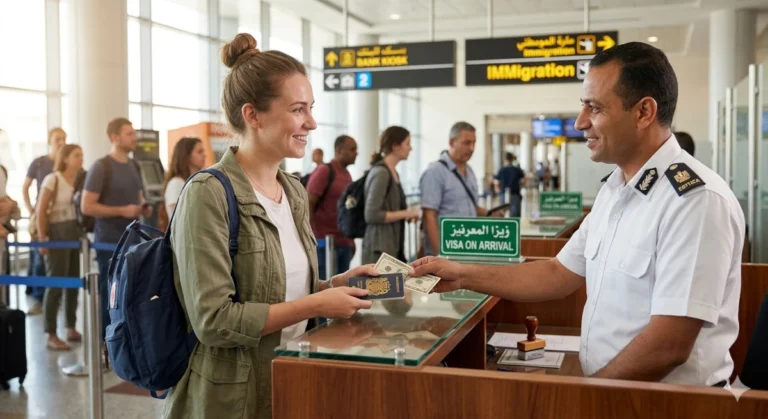
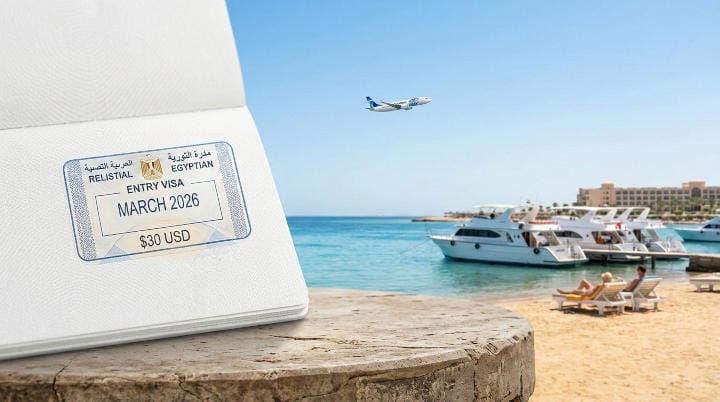
Visa on Arrival: For UK passport holders, the tourist visa fee is increasing to approx. £24 GBP (equivalent to $30 USD) effective 1 March 2026. If you arrive before this date, it remains approx. £20 GBP ($25 USD).
- Pro-Tip: While the bank kiosks in 2026 can technically take Sterling, the exchange rate they use at the counter is rarely in your favour.
- The Best Strategy: If you want to pay in GBP, bring a crisp £25 or £30 note. Be aware that they will likely give you your change in Egyptian Pounds (EGP). To save time and get the best value, most frequent travellers still recommend bringing the exact amount in USD if you have it, but Sterling is a perfectly valid backup.
Airport Transfers: Don’t haggle with “unregulated” taxis at the curb—they often try to charge upwards of £30–£40 for a 15-minute drive.
- Use Uber: A ride from Cairo Airport to Giza usually costs between £8 and £12 GBP (paid via the app).
- Pre-book: For Hurghada and Sharm, pre-booking a private transfer usually costs around £15–£20 GBP and saves you the “curbside headache.”